Key Takeaways:
-
H-E-B’s growth in Texas is increasingly centered on North Texas, where the Company is moving from market entry to market density.
-
RetailStat ROC: Retail Openings & Closings is currently tracking 45 H-E-B records across Texas, including 44 openings and 1 full-scale remodel.
-
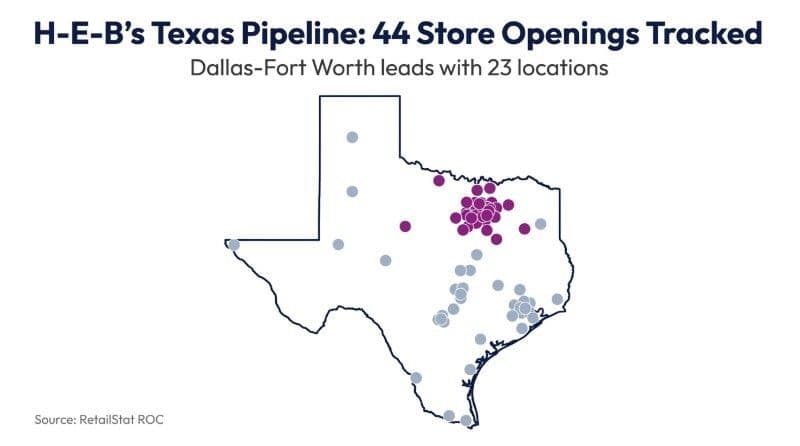
More than half of that tracked activity is concentrated in the Dallas-Fort Worth-Arlington CBSA, where RetailStat is tracking 23 H-E-B records.
-
H-E-B’s broader Texas activity also extends into Houston, Austin, San Antonio and smaller markets, but DFW is carrying the clearest momentum.
-
The Company’s North Texas store pipeline, paired with its planned supply chain campus in Valley View, points to a longer-term strategy built around coverage, convenience and competitive pressure.
H-E-B’s latest Texas expansion is not the same as a national grocer adding dots across a map.
The company’s footprint is concentrated in Texas and Mexico, which makes its current activity especially important. H-E-B is not spreading stores across every major U.S. market. It is deepening its position in the markets where it already has brand strength, operating experience, and customer loyalty. H-E-B operates more than 455 stores in Texas and Mexico, with sales of more than $50 billion.
That regional focus matters. In Texas, H-E-B is not just growing. It is tightening its grip on key markets, especially Dallas-Fort Worth.
H-E-B opened its Forney store in February, marking its 11th H-E-B location in the DFW Metroplex. The Company has also announced additional North Texas stores in Irving, Murphy, Mid-Cities, Walsh Ranch, Hillcrest, Carrollton and Denton.
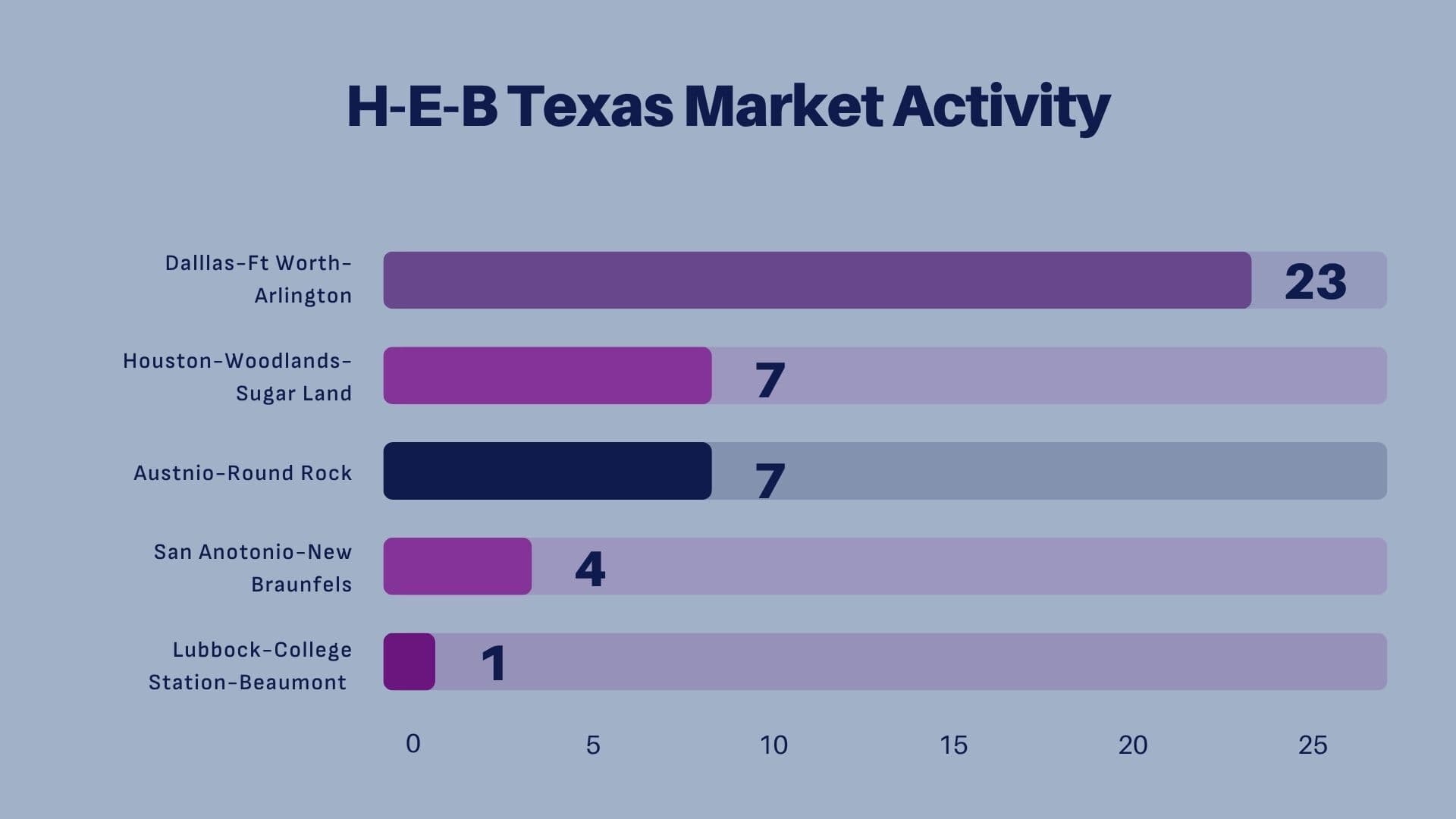
RetailStat ROC data reinforces that pattern. Across the H-E-B Texas activity currently tracked in ROC, Dallas-Fort Worth accounts for the largest share by far. RetailStat is tracking 45 H-E-B records across Texas, including 44 openings and one full-scale remodel. Of those, 23 are in the Dallas-Fort Worth-Arlington market. Houston and Austin each account for seven, followed by San Antonio with four.
Some of those records have TBD effective dates, which is common for longer-term pipeline activity. But the direction is clear: H-E-B’s Texas pipeline is broad, and North Texas is the center of gravity
 Source: RetailStat ROC
North Texas Is No Longer Just an Entry Market
H-E-B’s early DFW openings helped establish the brand in a market where shoppers had long known the Company by reputation but did not have the same store access as customers in Central and South Texas.
That phase is changing.
The Company is now adding stores across multiple North Texas communities, including established suburbs, fast-growing residential areas and infill locations. That creates a different competitive dynamic. One store can introduce a brand to a trade area. A network of stores can start to reshape shopping patterns.
The upcoming Mid Cities H-E-B is a good example. The store is set to open on May 20, 2026, serving the Euless and Bedford communities in Tarrant County. At about 126,000 square feet, the store includes a full-service pharmacy with drive-thru, True Texas BBQ, curbside pickup and home delivery.
Murphy is also moving forward with a store scheduled to open later in 2026. At 122,000 square feet, the store is expected to include many of the same large-format features, including pharmacy, True Texas BBQ, curbside and delivery.
Irving adds another important piece. The Company announced plans for its first H-E-B bannered store in Irving’s Las Colinas community, at Interstate 635 and Olympus Boulevard, with an expected opening in late 2026.
These are not small test stores. They are large-format H-E-B locations designed to bring the company’s full grocery experience into some of the most active parts of North Texas.
The Supply Chain Move Makes the Strategy Bigger
Store openings tell one part of the story. Infrastructure tells another.
In January, H-E-B purchased more than 600 acres in Valley View, about 60 miles north of Fort Worth, for a planned multi-phase supply chain campus to support its growing North Texas business.
That is a meaningful signal. A grocer does not make that kind of investment for a short-term rollout. It points to a longer runway for store growth, stronger regional coverage and a more durable operating base in a market where H-E-B is still building share.
For competitors, that should matter. H-E-B’s North Texas expansion is not just about the next opening date. It is about the operational backbone needed to support a denser store network over time.
Competition Is Building From Multiple Directions
Texas grocery was already competitive before H-E-B accelerated its North Texas push.
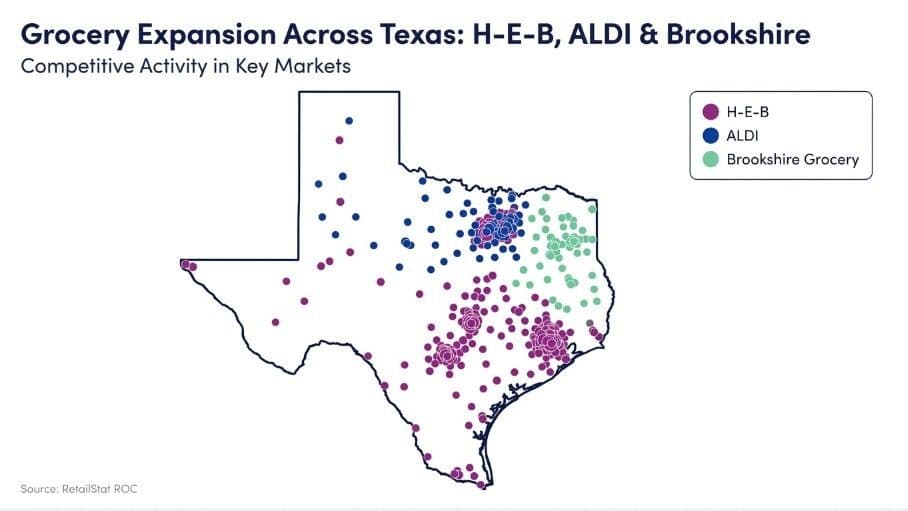
Walmart, Kroger, Costco, Aldi, Trader Joe’s, Sprouts and other food retailers are all active in parts of the state. That means H-E-B is not expanding into empty space. It is entering and deepening its presence in markets where operators are already fighting for households, real estate, convenience and loyalty.
That is where the DFW concentration becomes important.
A new H-E-B can affect a single trade area. A cluster of H-E-B stores can put pressure on a broader market. It can change shopping patterns, influence nearby store performance, affect future site selection and raise expectations around fresh food, prepared meals, curbside, pharmacy and price perception.
With SalesCast, RetailStat’s gravity modeling workflow, our team can estimate the dollar impact a new store opening may have on nearby grocery locations, helping identify which properties, competitors and trade areas may be most exposed as H-E-B builds density.
For retailers, landlords and real estate teams, the question is not only where H-E-B is opening next. The better question is what each new store does to the surrounding market.
-
Which trade areas become more competitive?
-
Which operators become more exposed?
-
Where is there enough household growth to support more grocery square footage?
-
Where does new activity point to confidence in long-term demand?
-
Where does density start to create risk?
Those questions become more important as expansion shifts from individual openings to market coverage.
Source: RetailStat ROC
What the RetailStat Data Shows
RetailStat ROC data shows H-E-B activity across several Texas markets, but the heaviest concentration is in Dallas-Fort Worth.
Source: RetailStat ROC
The statewide spread is still important. H-E-B continues to show activity across Texas, including major metros and smaller markets. But the DFW count stands out because it points to something more concentrated than general expansion.
North Texas is where the Company appears to be making its biggest current push.
The Real Read
H-E-B’s Texas expansion is becoming a market coverage play.
The Company is adding stores, building density in North Texas, investing in supply chain capacity and continuing to bring its full-format grocery model into competitive suburban markets. That combination makes the current expansion more significant than a list of store announcements.
For grocery operators and real estate teams, the takeaway is straightforward: H-E-B’s North Texas activity is creating a more competitive grocery environment in one of the country’s most attractive growth markets.
RetailStat helps clients track that movement as it happens, connecting openings, closings, remodels and future activity with market context so teams can better understand where competition is building and where opportunity remains.
The Bottom Line
H-E-B’s growth in Texas is not just about adding more stores to its home market. It is about building a stronger operating position in the markets that matter most.
Dallas-Fort Worth is the clearest example. RetailStat ROC data shows DFW accounts for more than half of the H-E-B Texas activity currently tracked, while public announcements and infrastructure investment point to a longer-term North Texas strategy.
For anyone watching grocery real estate, competitive pressure or market opportunity, H-E-B’s next phase in Texas is worth tracking closely.